
It starts with a sizzle.
A pan on the stove.
A steak, a kebab, a chicken curry—whatever your plate prefers.
But long before it reached your kitchen, this meal began elsewhere—deep in a system that’s quietly draining our planet.
The Story We’re Not Taught
We grow up hearing that food is culture, tradition, celebration.
What we rarely hear is that food is also the single most powerful environmental choice we make every day.
And when it comes to meat—the cost isn’t just paid in currency. It’s paid in forests, rivers, air, and climate.
Water: Disappearing Drop by Drop
Let’s begin with water.
To produce just 1 kg of beef, the system uses over 15,000 litres of water.
That’s enough to keep a tap running for five hours.
Compare that to tofu, which needs just 300 litres per kg.
The difference isn’t minor—it’s catastrophic.
And this isn’t just “farming.” It’s industrial-scale animal agriculture, with water used not only for the animals but to grow their feed.
Grains that could’ve fed people are used to fatten animals, in a world where millions still sleep hungry.
Air: Breathing in the Aftermath
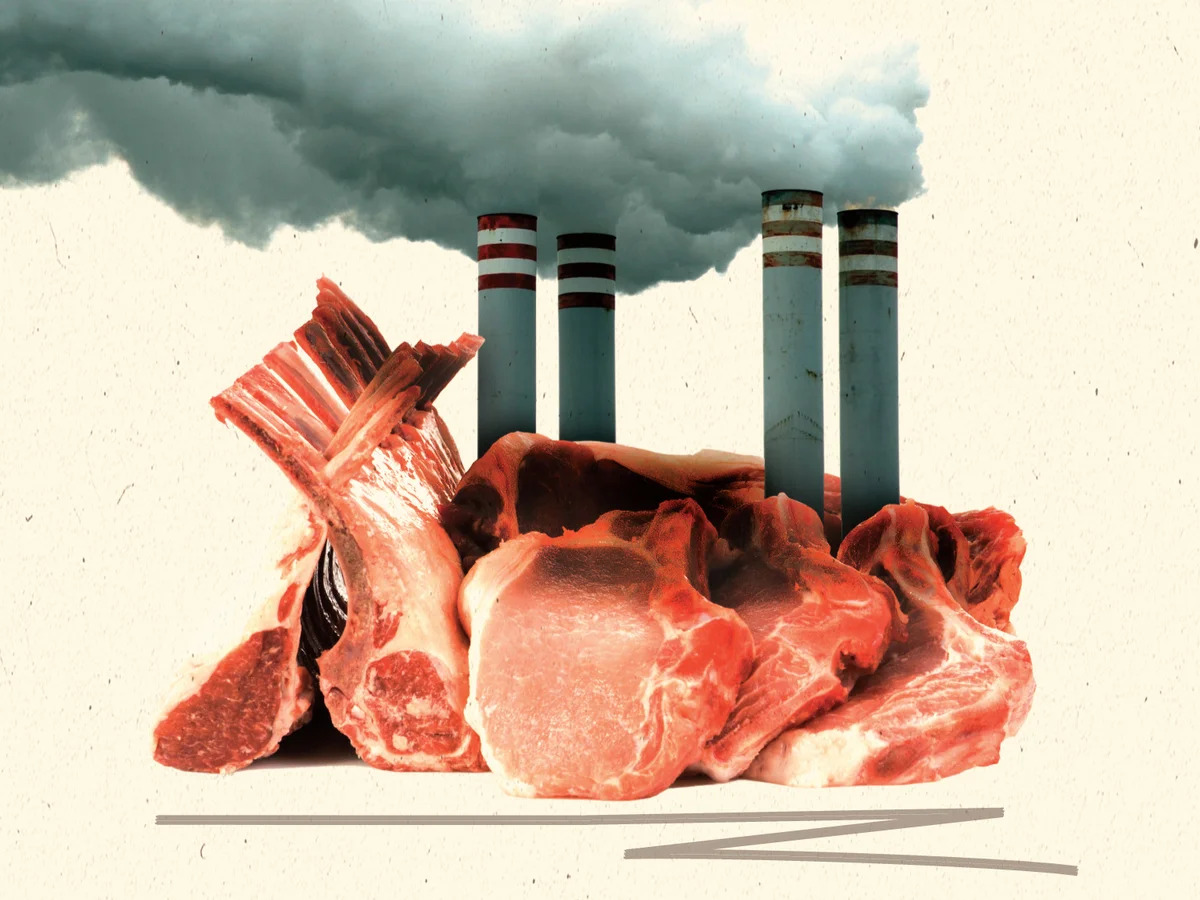
The meat industry is one of the world’s top contributors to greenhouse gas emissions.
Cows release methane, a gas that traps 80 times more heat than carbon dioxide over 20 years.
The scale?
If animal agriculture were a country, it would be the third-largest emitter on Earth—after China and the U.S.
We talk about cars and planes when we talk about climate change.
Rarely do we talk about our plates—even though our food choices are just as powerful.
Land: Forests Lost to Feedlots
To make space for grazing animals and growing their feed, we’re cutting down rainforests—tree by tree, acre by acre.
70% of the Amazon rainforest deforestation is directly linked to cattle farming.
These forests aren’t just green spaces. They’re carbon sinks, oxygen factories, homes to thousands of species.
When they fall, so does our future.
A Choice With Consequence
It’s easy to think, “But I’m just one person. What difference does my plate make?”
Here’s the truth:
If you choose a plant-based meal instead of meat, you save roughly 1,100 litres of water, 20 kg of CO₂, and 30 square feet of forest land—in just one day.
Now imagine doing that for a week. A month. A year.
Now imagine if millions joined in.
The Way Forward
This isn’t about guilt.
It’s about awareness.
It’s about understanding that behind the everyday comfort of meat lies an uncomfortable truth—a truth we can choose to change.
The future isn’t in factories.
It’s in our farms, our kitchens, our everyday decisions.
Let’s eat with intention.
Let’s be kind—not just to animals, but to the planet that holds us all.